


- Getting Started
- Hardware
- Software
- Brick Daemon (brickd)
- Brick Viewer (brickv)
- Brick Logger
- API Bindings
- ESP32 Firmware
- APT Repository
- Device Identifier
- Source Code and Bug Tracking
- Programming Interface
- Kits
- Embedded Boards
- Specifications
LabVIEW - IP Connection
This is the description of the LabVIEW API bindings for the IP Connection. The IP Connection manages the communication between the API bindings and the Brick Daemon or a WIFI/Ethernet Extension. Before Bricks and Bricklets can be controlled using their API an IP Connection has to be created and its TCP/IP connection has to be established.
An installation guide for the LabVIEW API bindings is part of their general description.
Examples
The example code below is Public Domain (CC0 1.0).
Enumerate
Download (Example Enumerate.vi), Download (Example Enumerate - EnumerateCallback Callback.vi)

Authenticate
Download (Example Authenticate.vi), Download (Example Authenticate - Connected Callback.vi) Download (Example Authenticate - EnumerateCallback Callback.vi)
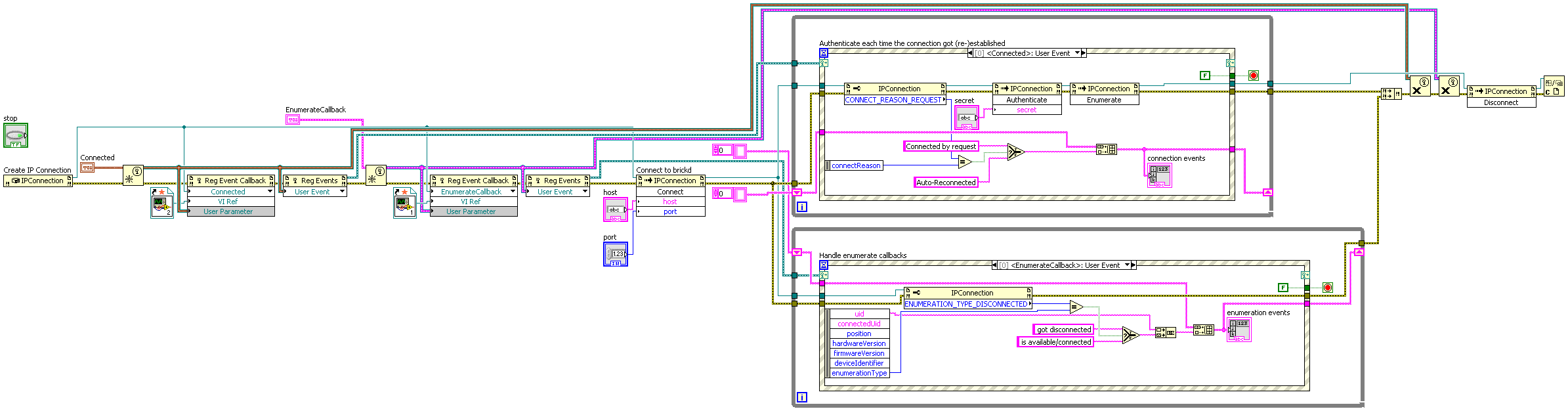
API
The namespace for the IPConnection is Tinkerforge.*.
Basic Functions
- IPConnection() ipcon
- Output:
ipcon -- .NET Refnum (IPConnection)
Creates an IP Connection object that can be used to enumerate the available devices. It is also required for the constructor of Bricks and Bricklets.
- IPConnection.Connect(host, port)
- Input:
host -- String
port -- Int32
Creates a TCP/IP connection to the given
hostandport. The host and port can refer to a Brick Daemon or to a WIFI/Ethernet Extension.Devices can only be controlled when the connection was established successfully.
Blocks until the connection is established and throws an exception if there is no Brick Daemon or WIFI/Ethernet Extension listening at the given host and port.
- IPConnection.Disconnect()
Disconnects the TCP/IP connection from the Brick Daemon or the WIFI/Ethernet Extension.
- IPConnection.Authenticate(secret)
- Input:
secret -- String
Performs an authentication handshake with the connected Brick Daemon or WIFI/Ethernet Extension. If the handshake succeeds the connection switches from non-authenticated to authenticated state and communication can continue as normal. If the handshake fails then the connection gets closed. Authentication can fail if the wrong secret was used or if authentication is not enabled at all on the Brick Daemon or the WIFI/Ethernet Extension.
See the authentication tutorial for more information.
New in version 2.1.0.
- IPConnection.GetConnectionState() connectionState
- Output:
connectionState -- Byte
Can return the following states:
IPConnection.CONNECTION_STATE_DISCONNECTED = 0: No connection is established.
IPConnection.CONNECTION_STATE_CONNECTED = 1: A connection to the Brick Daemon or the WIFI/Ethernet Extension is established.
IPConnection.CONNECTION_STATE_PENDING = 2: IP Connection is currently trying to connect.
- IPConnection.SetAutoReconnect(autoReconnect)
- Input:
autoReconnect -- Boolean
Enables or disables auto-reconnect. If auto-reconnect is enabled, the IP Connection will try to reconnect to the previously given host and port, if the currently existing connection is lost. Therefore, auto-reconnect only does something after a successful
Connect()call.Default value is true.
- IPConnection.GetAutoReconnect() autoReconnect
- Output:
autoReconnect -- Boolean
Returns true if auto-reconnect is enabled, false otherwise.
- IPConnection.SetTimeout(timeout)
- Input:
timeout -- Int32
Sets the timeout in milliseconds for getters and for setters for which the response expected flag is activated.
Default timeout is 2500.
- IPConnection.GetTimeout() timeout
- Output:
timeout -- Int32
Returns the timeout as set by
SetTimeout().
- IPConnection.Enumerate()
Broadcasts an enumerate request. All devices will respond with an enumerate callback.
Callbacks
Callbacks can be registered to be notified about events. The registration is done by appending your callback handler to the corresponding event. The available events are described below.
- event IPConnection.EnumerateCallback(sender, uid, connectedUid, position, hardwareVersion, firmwareVersion, deviceIdentifier, enumerationType)
- Input:
sender -- .NET Refnum (IPConnection)
uid -- String
connectedUid -- String
position -- Char
hardwareVersion -- Byte[3]
firmwareVersion -- Byte[3]
deviceIdentifier -- Int32
enumerationType -- Int16
The event receives seven parameters:
uid: The UID of the device.connectedUid: UID where the device is connected to. For a Bricklet this is the UID of the Brick or Bricklet it is connected to. For a Brick it is the UID of the bottommost Brick in the stack. For the bottommost Brick in a stack it is "0". With this information it is possible to reconstruct the complete network topology.position: For Bricks: '0' - '8' (position in stack). For Bricklets: 'a' - 'h' (position on Brick) or 'i' (position of the Raspberry Pi (Zero) HAT) or 'z' (Bricklet on Isolator Bricklet).hardwareVersion: Major, minor and release number for hardware version.firmwareVersion: Major, minor and release number for firmware version.deviceIdentifier: A number that represents the device.enumerationType: Type of enumeration.
Possible enumeration types are:
IPConnection.ENUMERATION_TYPE_AVAILABLE = 0: Device is available (enumeration triggered by user:
Enumerate()). This enumeration type can occur multiple times for the same device.IPConnection.ENUMERATION_TYPE_CONNECTED = 1: Device is newly connected (automatically send by Brick after establishing a communication connection). This indicates that the device has potentially lost its previous configuration and needs to be reconfigured.
IPConnection.ENUMERATION_TYPE_DISCONNECTED = 2: Device is disconnected (only possible for USB connection). In this case only
uidandenumerationTypeare valid.
It should be possible to implement plug-and-play functionality with this (as is done in Brick Viewer).
The device identifier numbers can be found here. There are also constants for these numbers named following this pattern:
<device-class>.DEVICE_IDENTIFIER
For example:
BrickMaster.DEVICE_IDENTIFIERorBrickletAmbientLight.DEVICE_IDENTIFIER.
- event IPConnection.ConnectedCallback(sender, connectReason)
- Input:
sender -- .NET Refnum (IPConnection)
connectReason -- Int16
This event is triggered whenever the IP Connection got connected to a Brick Daemon or to a WIFI/Ethernet Extension, possible reasons are:
IPConnection.CONNECT_REASON_REQUEST = 0: Connection established after request from user.
IPConnection.CONNECT_REASON_AUTO_RECONNECT = 1: Connection after auto-reconnect.
- event IPConnection.DisconnectedCallback(sender, disconnectReason)
- Input:
sender -- .NET Refnum (IPConnection)
disconnectReason -- Int16
This event is triggered whenever the IP Connection got disconnected from a Brick Daemon or to a WIFI/Ethernet Extension, possible reasons are:
IPConnection.DISCONNECT_REASON_REQUEST = 0: Disconnect was requested by user.
IPConnection.DISCONNECT_REASON_ERROR = 1: Disconnect because of an unresolvable error.
IPConnection.DISCONNECT_REASON_SHUTDOWN = 2: Disconnect initiated by Brick Daemon or WIFI/Ethernet Extension.