


- Getting Started
- Hardware
- Software
- Brick Daemon (brickd)
- Brick Viewer (brickv)
- Brick Logger
- API Bindings
- C/C++
- C/C++ (iOS)
- C/C++ for Microcontrollers
- C#
- C# (Windows Phone)
- Delphi/Lazarus
- Go
- Java
- Java (Android)
- JavaScript
- LabVIEW
- Mathematica
- MATLAB/Octave
- Requirements
- Installation
- Testing an Example
- Known Issues
- API Reference and Examples
- IP Connection
- Bricks
- Bricks (Discontinued)
- Bricklets
- Accelerometer Bricklet 2.0
- Air Quality Bricklet
- Ambient Light Bricklet 3.0
- Analog In Bricklet 3.0
- Analog Out Bricklet 3.0
- Barometer Bricklet
- Barometer Bricklet 2.0
- CAN Bricklet
- CAN Bricklet 2.0
- CO2 Bricklet 2.0
- Color Bricklet
- Color Bricklet 2.0
- Compass Bricklet
- DC Bricklet 2.0
- Distance IR Bricklet
- Distance IR Bricklet 2.0
- Distance US Bricklet 2.0
- DMX Bricklet
- Dual Button Bricklet 2.0
- Dust Detector Bricklet
- E-Paper 296x128 Bricklet
- Energy Monitor Bricklet
- GPS Bricklet 2.0
- GPS Bricklet 3.0
- Hall Effect Bricklet
- Hall Effect Bricklet 2.0
- Humidity Bricklet 2.0
- IMU Bricklet 3.0
- Industrial Analog Out Bricklet 2.0
- Industrial Counter Bricklet
- Industrial Digital In 4 Bricklet 2.0
- Industrial Digital Out 4 Bricklet
- Industrial Digital Out 4 Bricklet 2.0
- Industrial Dual 0-20mA Bricklet
- Industrial Dual 0-20mA Bricklet 2.0
- Industrial Dual AC In Bricklet
- Industrial Dual AC Relay Bricklet
- Industrial Dual Analog In Bricklet 2.0
- Industrial Dual Relay Bricklet
- Industrial PTC Bricklet
- Industrial Quad Relay Bricklet 2.0
- IO-16 Bricklet
- IO-16 Bricklet 2.0
- IO-4 Bricklet 2.0
- Isolator Bricklet
- Joystick Bricklet
- Joystick Bricklet 2.0
- Laser Range Finder Bricklet 2.0
- LCD 128x64 Bricklet
- LCD 20x4 Bricklet
- LED Strip Bricklet 2.0
- Line Bricklet
- Linear Poti Bricklet
- Linear Poti Bricklet 2.0
- Load Cell Bricklet 2.0
- Motion Detector Bricklet 2.0
- Motorized Linear Poti Bricklet
- Multi Touch Bricklet
- Multi Touch Bricklet 2.0
- NFC Bricklet
- OLED 128x64 Bricklet 2.0
- OLED 64x48 Bricklet
- One Wire Bricklet
- Outdoor Weather Bricklet
- Particulate Matter Bricklet
- Performance DC Bricklet
- Piezo Speaker Bricklet
- Piezo Speaker Bricklet 2.0
- Real-Time Clock Bricklet
- Real-Time Clock Bricklet 2.0
- Remote Switch Bricklet 2.0
- RGB LED Bricklet 2.0
- RGB LED Button Bricklet
- Rotary Encoder Bricklet 2.0
- Rotary Poti Bricklet
- Rotary Poti Bricklet 2.0
- RS232 Bricklet
- RS232 Bricklet 2.0
- RS485 Bricklet
- Segment Display 4x7 Bricklet
- Segment Display 4x7 Bricklet 2.0
- Servo Bricklet 2.0
- Silent Stepper Bricklet 2.0
- Solid State Relay Bricklet 2.0
- Sound Intensity Bricklet
- Sound Pressure Level Bricklet
- Temperature Bricklet
- Temperature Bricklet 2.0
- Temperature IR Bricklet 2.0
- Thermal Imaging Bricklet
- Thermocouple Bricklet 2.0
- Tilt Bricklet
- UV Light Bricklet 2.0
- Voltage/Current Bricklet 2.0
- XMC1400 Breakout Bricklet
- Bricklets (Discontinued)
- MQTT
- openHAB
- Perl
- PHP
- Python
- Ruby
- Rust
- Shell
- Visual Basic .NET
- ESP32 Firmware
- APT Repository
- Device Identifier
- Source Code and Bug Tracking
- Programming Interface
- Kits
- Embedded Boards
- Specifications
MATLAB/Octave - Color Bricklet
This is the description of the MATLAB/Octave API bindings for the Color Bricklet. General information and technical specifications for the Color Bricklet are summarized in its hardware description.
An installation guide for the MATLAB/Octave API bindings is part of their general description.
Examples
The example code below is Public Domain (CC0 1.0).
Simple (MATLAB)
Download (matlab_example_simple.m)
 1function matlab_example_simple()
 2    import com.tinkerforge.IPConnection;
 3    import com.tinkerforge.BrickletColor;
 4
 5    HOST = 'localhost';
 6    PORT = 4223;
 7    UID = 'XYZ'; % Change XYZ to the UID of your Color Bricklet
 8
 9    ipcon = IPConnection(); % Create IP connection
10    c = handle(BrickletColor(UID, ipcon), 'CallbackProperties'); % Create device object
11
12    ipcon.connect(HOST, PORT); % Connect to brickd
13    % Don't use device before ipcon is connected
14
15    % Get current color
16    color = c.getColor();
17
18    fprintf('Color [R]: %i\n', color.r);
19    fprintf('Color [G]: %i\n', color.g);
20    fprintf('Color [B]: %i\n', color.b);
21    fprintf('Color [C]: %i\n', color.c);
22
23    input('Press key to exit\n', 's');
24    ipcon.disconnect();
25end
Callback (MATLAB)
Download (matlab_example_callback.m)
 1function matlab_example_callback()
 2    import com.tinkerforge.IPConnection;
 3    import com.tinkerforge.BrickletColor;
 4
 5    HOST = 'localhost';
 6    PORT = 4223;
 7    UID = 'XYZ'; % Change XYZ to the UID of your Color Bricklet
 8
 9    ipcon = IPConnection(); % Create IP connection
10    c = handle(BrickletColor(UID, ipcon), 'CallbackProperties'); % Create device object
11
12    ipcon.connect(HOST, PORT); % Connect to brickd
13    % Don't use device before ipcon is connected
14
15    % Register color callback to function cb_color
16    set(c, 'ColorCallback', @(h, e) cb_color(e));
17
18    % Set period for color callback to 1s (1000ms)
19    % Note: The color callback is only called every second
20    %       if the color has changed since the last call!
21    c.setColorCallbackPeriod(1000);
22
23    input('Press key to exit\n', 's');
24    ipcon.disconnect();
25end
26
27% Callback function for color callback
28function cb_color(e)
29    fprintf('Color [R]: %i\n', e.r);
30    fprintf('Color [G]: %i\n', e.g);
31    fprintf('Color [B]: %i\n', e.b);
32    fprintf('Color [C]: %i\n', e.c);
33    fprintf('\n');
34end
Threshold (MATLAB)
Download (matlab_example_threshold.m)
 1function matlab_example_threshold()
 2    import com.tinkerforge.IPConnection;
 3    import com.tinkerforge.BrickletColor;
 4
 5    HOST = 'localhost';
 6    PORT = 4223;
 7    UID = 'XYZ'; % Change XYZ to the UID of your Color Bricklet
 8
 9    ipcon = IPConnection(); % Create IP connection
10    c = handle(BrickletColor(UID, ipcon), 'CallbackProperties'); % Create device object
11
12    ipcon.connect(HOST, PORT); % Connect to brickd
13    % Don't use device before ipcon is connected
14
15    % Get threshold callbacks with a debounce time of 10 seconds (10000ms)
16    c.setDebouncePeriod(10000);
17
18    % Register color reached callback to function cb_color_reached
19    set(c, 'ColorReachedCallback', @(h, e) cb_color_reached(e));
20
21    % Configure threshold for color "greater than 100, 200, 300, 400"
22    c.setColorCallbackThreshold('>', 100, 0, 200, 0, 300, 0, 400, 0);
23
24    input('Press key to exit\n', 's');
25    ipcon.disconnect();
26end
27
28% Callback function for color reached callback
29function cb_color_reached(e)
30    fprintf('Color [R]: %i\n', e.r);
31    fprintf('Color [G]: %i\n', e.g);
32    fprintf('Color [B]: %i\n', e.b);
33    fprintf('Color [C]: %i\n', e.c);
34    fprintf('\n');
35end
Simple (Octave)
Download (octave_example_simple.m)
 1function octave_example_simple()
 2    more off;
 3
 4    HOST = "localhost";
 5    PORT = 4223;
 6    UID = "XYZ"; % Change XYZ to the UID of your Color Bricklet
 7
 8    ipcon = javaObject("com.tinkerforge.IPConnection"); % Create IP connection
 9    c = javaObject("com.tinkerforge.BrickletColor", UID, ipcon); % Create device object
10
11    ipcon.connect(HOST, PORT); % Connect to brickd
12    % Don't use device before ipcon is connected
13
14    % Get current color
15    color = c.getColor();
16
17    fprintf("Color [R]: %d\n", color.r);
18    fprintf("Color [G]: %d\n", color.g);
19    fprintf("Color [B]: %d\n", color.b);
20    fprintf("Color [C]: %d\n", color.c);
21
22    input("Press key to exit\n", "s");
23    ipcon.disconnect();
24end
Callback (Octave)
Download (octave_example_callback.m)
 1function octave_example_callback()
 2    more off;
 3
 4    HOST = "localhost";
 5    PORT = 4223;
 6    UID = "XYZ"; % Change XYZ to the UID of your Color Bricklet
 7
 8    ipcon = javaObject("com.tinkerforge.IPConnection"); % Create IP connection
 9    c = javaObject("com.tinkerforge.BrickletColor", UID, ipcon); % Create device object
10
11    ipcon.connect(HOST, PORT); % Connect to brickd
12    % Don't use device before ipcon is connected
13
14    % Register color callback to function cb_color
15    c.addColorCallback(@cb_color);
16
17    % Set period for color callback to 1s (1000ms)
18    % Note: The color callback is only called every second
19    %       if the color has changed since the last call!
20    c.setColorCallbackPeriod(1000);
21
22    input("Press key to exit\n", "s");
23    ipcon.disconnect();
24end
25
26% Callback function for color callback
27function cb_color(e)
28    fprintf("Color [R]: %d\n", e.r);
29    fprintf("Color [G]: %d\n", e.g);
30    fprintf("Color [B]: %d\n", e.b);
31    fprintf("Color [C]: %d\n", e.c);
32    fprintf("\n");
33end
Threshold (Octave)
Download (octave_example_threshold.m)
 1function octave_example_threshold()
 2    more off;
 3
 4    HOST = "localhost";
 5    PORT = 4223;
 6    UID = "XYZ"; % Change XYZ to the UID of your Color Bricklet
 7
 8    ipcon = javaObject("com.tinkerforge.IPConnection"); % Create IP connection
 9    c = javaObject("com.tinkerforge.BrickletColor", UID, ipcon); % Create device object
10
11    ipcon.connect(HOST, PORT); % Connect to brickd
12    % Don't use device before ipcon is connected
13
14    % Get threshold callbacks with a debounce time of 10 seconds (10000ms)
15    c.setDebouncePeriod(10000);
16
17    % Register color reached callback to function cb_color_reached
18    c.addColorReachedCallback(@cb_color_reached);
19
20    % Configure threshold for color "greater than 100, 200, 300, 400"
21    c.setColorCallbackThreshold(">", 100, 0, 200, 0, 300, 0, 400, 0);
22
23    input("Press key to exit\n", "s");
24    ipcon.disconnect();
25end
26
27% Callback function for color reached callback
28function cb_color_reached(e)
29    fprintf("Color [R]: %d\n", e.r);
30    fprintf("Color [G]: %d\n", e.g);
31    fprintf("Color [B]: %d\n", e.b);
32    fprintf("Color [C]: %d\n", e.c);
33    fprintf("\n");
34end
API
Generally, every method of the MATLAB bindings that returns a value can
throw a TimeoutException. This exception gets thrown if the
device did not respond. If a cable based connection is used, it is
unlikely that this exception gets thrown (assuming nobody unplugs the
device). However, if a wireless connection is used, timeouts will occur
if the distance to the device gets too big.
Beside the TimeoutException there is also a NotConnectedException that
is thrown if a method needs to communicate with the device while the
IP Connection is not connected.
Since the MATLAB bindings are based on Java and Java does not support multiple return values and return by reference is not possible for primitive types, we use small classes that only consist of member variables. The member variables of the returned objects are described in the corresponding method descriptions.
The package for all Brick/Bricklet bindings and the IP Connection is
com.tinkerforge.*
All methods listed below are thread-safe.
Basic Functions
- class BrickletColor(String uid, IPConnection ipcon)
Parameters: - uid – Type: String
- ipcon – Type: IPConnection
Returns: - color – Type: BrickletColor
Creates an object with the unique device ID
uid.In MATLAB:
import com.tinkerforge.BrickletColor;

color = BrickletColor('YOUR_DEVICE_UID', ipcon);
In Octave:
color = java_new("com.tinkerforge.BrickletColor", "YOUR_DEVICE_UID", ipcon);
This object can then be used after the IP Connection is connected.
- BrickletColor.Color BrickletColor.getColor()
Return Object: - r – Type: int, Range: [0 to 216 - 1]
- g – Type: int, Range: [0 to 216 - 1]
- b – Type: int, Range: [0 to 216 - 1]
- c – Type: int, Range: [0 to 216 - 1]
Returns the measured color of the sensor.
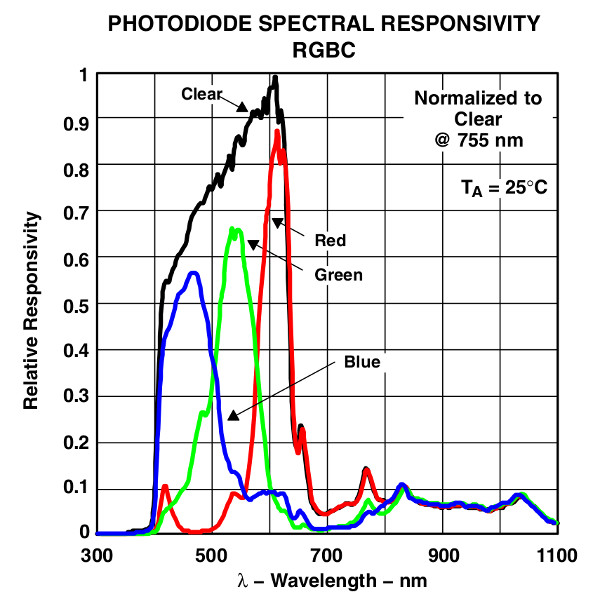
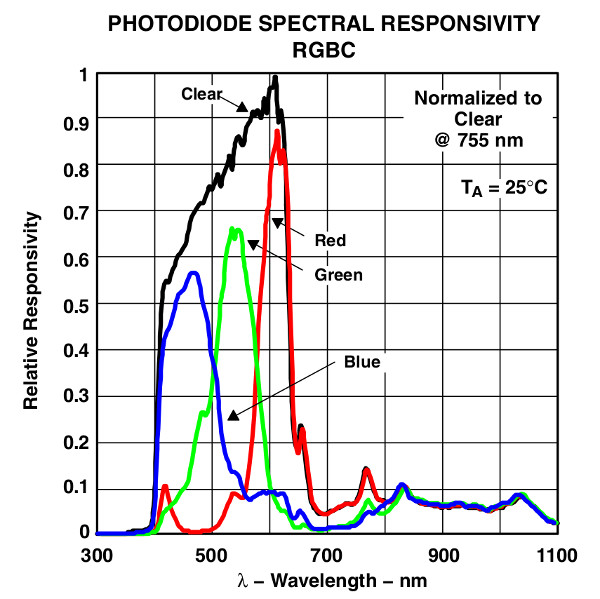
The red (r), green (g), blue (b) and clear (c) colors are measured with four different photodiodes that are responsive at different wavelengths:
If you want to get the color periodically, it is recommended to use the
ColorCallbackcallback and set the period withsetColorCallbackPeriod().
- void BrickletColor.lightOn()
Turns the LED on.
- void BrickletColor.lightOff()
Turns the LED off.
- short BrickletColor.isLightOn()
Returns: - light – Type: short, Range: See constants, Default: 1
Returns the state of the LED. Possible values are:
0: On
1: Off
The following constants are available for this function:
For light:
BrickletColor.LIGHT_ON = 0
BrickletColor.LIGHT_OFF = 1
- void BrickletColor.setConfig(short gain, short integrationTime)
Parameters: - gain – Type: short, Range: See constants, Default: 3
- integrationTime – Type: short, Range: See constants, Default: 3
Sets the configuration of the sensor. Gain and integration time can be configured in this way.
For configuring the gain:
0: 1x Gain
1: 4x Gain
2: 16x Gain
3: 60x Gain
For configuring the integration time:
0: 2.4ms
1: 24ms
2: 101ms
3: 154ms
4: 700ms
Increasing the gain enables the sensor to detect a color from a higher distance.
The integration time provides a trade-off between conversion time and accuracy. With a longer integration time the values read will be more accurate but it will take longer time to get the conversion results.
The following constants are available for this function:
For gain:
BrickletColor.GAIN_1X = 0
BrickletColor.GAIN_4X = 1
BrickletColor.GAIN_16X = 2
BrickletColor.GAIN_60X = 3
For integrationTime:
BrickletColor.INTEGRATION_TIME_2MS = 0
BrickletColor.INTEGRATION_TIME_24MS = 1
BrickletColor.INTEGRATION_TIME_101MS = 2
BrickletColor.INTEGRATION_TIME_154MS = 3
BrickletColor.INTEGRATION_TIME_700MS = 4
- BrickletColor.Config BrickletColor.getConfig()
Return Object: - gain – Type: short, Range: See constants, Default: 3
- integrationTime – Type: short, Range: See constants, Default: 3
Returns the configuration as set by
setConfig().The following constants are available for this function:
For gain:
BrickletColor.GAIN_1X = 0
BrickletColor.GAIN_4X = 1
BrickletColor.GAIN_16X = 2
BrickletColor.GAIN_60X = 3
For integrationTime:
BrickletColor.INTEGRATION_TIME_2MS = 0
BrickletColor.INTEGRATION_TIME_24MS = 1
BrickletColor.INTEGRATION_TIME_101MS = 2
BrickletColor.INTEGRATION_TIME_154MS = 3
BrickletColor.INTEGRATION_TIME_700MS = 4
- long BrickletColor.getIlluminance()
Returns: - illuminance – Type: long, Unit: ? lx, Range: [0 to 103438]
Returns the illuminance affected by the gain and integration time as set by
setConfig(). To get the illuminance in Lux apply this formula:lux = illuminance * 700 / gain / integration_time
To get a correct illuminance measurement make sure that the color values themselves are not saturated. The color value (R, G or B) is saturated if it is equal to the maximum value of 65535. In that case you have to reduce the gain, see
setConfig().
- int BrickletColor.getColorTemperature()
Returns: - colorTemperature – Type: int, Unit: 1 K, Range: [0 to 216 - 1]
Returns the color temperature.
To get a correct color temperature measurement make sure that the color values themselves are not saturated. The color value (R, G or B) is saturated if it is equal to the maximum value of 65535. In that case you have to reduce the gain, see
setConfig().
Advanced Functions
- BrickletColor.Identity BrickletColor.getIdentity()
Return Object: - uid – Type: String, Length: up to 8
- connectedUid – Type: String, Length: up to 8
- position – Type: char, Range: ['a' to 'h', 'z']
- hardwareVersion – Type: short[], Length: 3
- 1: major – Type: short, Range: [0 to 255]
- 2: minor – Type: short, Range: [0 to 255]
- 3: revision – Type: short, Range: [0 to 255]
- firmwareVersion – Type: short[], Length: 3
- 1: major – Type: short, Range: [0 to 255]
- 2: minor – Type: short, Range: [0 to 255]
- 3: revision – Type: short, Range: [0 to 255]
- deviceIdentifier – Type: int, Range: [0 to 216 - 1]
Returns the UID, the UID where the Bricklet is connected to, the position, the hardware and firmware version as well as the device identifier.
The position can be 'a', 'b', 'c', 'd', 'e', 'f', 'g' or 'h' (Bricklet Port). A Bricklet connected to an Isolator Bricklet is always at position 'z'.
The device identifier numbers can be found here. There is also a constant for the device identifier of this Bricklet.
Callback Configuration Functions
- void BrickletColor.setColorCallbackPeriod(long period)
Parameters: - period – Type: long, Unit: 1 ms, Range: [0 to 232 - 1], Default: 0
Sets the period with which the
ColorCallbackcallback is triggered periodically. A value of 0 turns the callback off.The
ColorCallbackcallback is only triggered if the color has changed since the last triggering.
- long BrickletColor.getColorCallbackPeriod()
Returns: - period – Type: long, Unit: 1 ms, Range: [0 to 232 - 1], Default: 0
Returns the period as set by
setColorCallbackPeriod().
- void BrickletColor.setColorCallbackThreshold(char option, int minR, int maxR, int minG, int maxG, int minB, int maxB, int minC, int maxC)
Parameters: - option – Type: char, Range: See constants, Default: 'x'
- minR – Type: int, Range: [0 to 216 - 1], Default: 0
- maxR – Type: int, Range: [0 to 216 - 1], Default: 0
- minG – Type: int, Range: [0 to 216 - 1], Default: 0
- maxG – Type: int, Range: [0 to 216 - 1], Default: 0
- minB – Type: int, Range: [0 to 216 - 1], Default: 0
- maxB – Type: int, Range: [0 to 216 - 1], Default: 0
- minC – Type: int, Range: [0 to 216 - 1], Default: 0
- maxC – Type: int, Range: [0 to 216 - 1], Default: 0
Sets the thresholds for the
ColorReachedCallbackcallback.The following options are possible:
Option
Description
'x'
Callback is turned off
'o'
Callback is triggered when the temperature is outside the min and max values
'i'
Callback is triggered when the temperature is inside the min and max values
'<'
Callback is triggered when the temperature is smaller than the min value (max is ignored)
'>'
Callback is triggered when the temperature is greater than the min value (max is ignored)
The following constants are available for this function:
For option:
BrickletColor.THRESHOLD_OPTION_OFF = 'x'
BrickletColor.THRESHOLD_OPTION_OUTSIDE = 'o'
BrickletColor.THRESHOLD_OPTION_INSIDE = 'i'
BrickletColor.THRESHOLD_OPTION_SMALLER = '<'
BrickletColor.THRESHOLD_OPTION_GREATER = '>'
- BrickletColor.ColorCallbackThreshold BrickletColor.getColorCallbackThreshold()
Return Object: - option – Type: char, Range: See constants, Default: 'x'
- minR – Type: int, Range: [0 to 216 - 1], Default: 0
- maxR – Type: int, Range: [0 to 216 - 1], Default: 0
- minG – Type: int, Range: [0 to 216 - 1], Default: 0
- maxG – Type: int, Range: [0 to 216 - 1], Default: 0
- minB – Type: int, Range: [0 to 216 - 1], Default: 0
- maxB – Type: int, Range: [0 to 216 - 1], Default: 0
- minC – Type: int, Range: [0 to 216 - 1], Default: 0
- maxC – Type: int, Range: [0 to 216 - 1], Default: 0
Returns the threshold as set by
setColorCallbackThreshold().The following constants are available for this function:
For option:
BrickletColor.THRESHOLD_OPTION_OFF = 'x'
BrickletColor.THRESHOLD_OPTION_OUTSIDE = 'o'
BrickletColor.THRESHOLD_OPTION_INSIDE = 'i'
BrickletColor.THRESHOLD_OPTION_SMALLER = '<'
BrickletColor.THRESHOLD_OPTION_GREATER = '>'
- void BrickletColor.setDebouncePeriod(long debounce)
Parameters: - debounce – Type: long, Unit: 1 ms, Range: [0 to 232 - 1], Default: 100
Sets the period with which the threshold callback
is triggered, if the threshold
keeps being reached.
- long BrickletColor.getDebouncePeriod()
Returns: - debounce – Type: long, Unit: 1 ms, Range: [0 to 232 - 1], Default: 100
Returns the debounce period as set by
setDebouncePeriod().
- void BrickletColor.setIlluminanceCallbackPeriod(long period)
Parameters: - period – Type: long, Unit: 1 ms, Range: [0 to 232 - 1], Default: 0
Sets the period with which the
IlluminanceCallbackcallback is triggered periodically. A value of 0 turns the callback off.The
IlluminanceCallbackcallback is only triggered if the illuminance has changed since the last triggering.
- long BrickletColor.getIlluminanceCallbackPeriod()
Returns: - period – Type: long, Unit: 1 ms, Range: [0 to 232 - 1], Default: 0
Returns the period as set by
setIlluminanceCallbackPeriod().
- void BrickletColor.setColorTemperatureCallbackPeriod(long period)
Parameters: - period – Type: long, Unit: 1 ms, Range: [0 to 232 - 1], Default: 0
Sets the period with which the
ColorTemperatureCallbackcallback is triggered periodically. A value of 0 turns the callback off.The
ColorTemperatureCallbackcallback is only triggered if the color temperature has changed since the last triggering.
- long BrickletColor.getColorTemperatureCallbackPeriod()
Returns: - period – Type: long, Unit: 1 ms, Range: [0 to 232 - 1], Default: 0
Returns the period as set by
setColorTemperatureCallbackPeriod().
Callbacks
Callbacks can be registered to receive time critical or recurring data from the device. The registration is done with "set" function of MATLAB. The parameters consist of the IP Connection object, the callback name and the callback function. For example, it looks like this in MATLAB:
function my_callback(e)
    fprintf('Parameter: %s\n', e.param);
end

set(device, 'ExampleCallback', @(h, e) my_callback(e));
Due to a difference in the Octave Java support the "set" function cannot be used in Octave. The registration is done with "add*Callback" functions of the device object. It looks like this in Octave:
function my_callback(e)
    fprintf("Parameter: %s\n", e.param);
end

device.addExampleCallback(@my_callback);
It is possible to add several callbacks and to remove them with the corresponding "remove*Callback" function.
The parameters of the callback are passed to the callback function as fields of
the structure e, which is derived from the java.util.EventObject class.
The available callback names with corresponding structure fields are described
below.
Note
Using callbacks for recurring events is always preferred compared to using getters. It will use less USB bandwidth and the latency will be a lot better, since there is no round trip time.
- callback BrickletColor.ColorCallback
Event Object: - r – Type: int, Range: [0 to 216 - 1]
- g – Type: int, Range: [0 to 216 - 1]
- b – Type: int, Range: [0 to 216 - 1]
- c – Type: int, Range: [0 to 216 - 1]
This callback is triggered periodically with the period that is set by
setColorCallbackPeriod(). The parameter is the color of the sensor as RGBC.The
ColorCallbackcallback is only triggered if the color has changed since the last triggering.In MATLAB the
set()function can be used to register a callback function to this callback.In Octave a callback function can be added to this callback using the
addColorCallback()function. An added callback function can be removed with theremoveColorCallback()function.
- callback BrickletColor.ColorReachedCallback
Event Object: - r – Type: int, Range: [0 to 216 - 1]
- g – Type: int, Range: [0 to 216 - 1]
- b – Type: int, Range: [0 to 216 - 1]
- c – Type: int, Range: [0 to 216 - 1]
This callback is triggered when the threshold as set by
setColorCallbackThreshold()is reached. The parameter is the color of the sensor as RGBC.If the threshold keeps being reached, the callback is triggered periodically with the period as set by
setDebouncePeriod().In MATLAB the
set()function can be used to register a callback function to this callback.In Octave a callback function can be added to this callback using the
addColorReachedCallback()function. An added callback function can be removed with theremoveColorReachedCallback()function.
- callback BrickletColor.IlluminanceCallback
Event Object: - illuminance – Type: long, Unit: ? lx, Range: [0 to 103438]
This callback is triggered periodically with the period that is set by
setIlluminanceCallbackPeriod(). The parameter is the illuminance. SeegetIlluminance()for how to interpret this value.The
IlluminanceCallbackcallback is only triggered if the illuminance has changed since the last triggering.In MATLAB the
set()function can be used to register a callback function to this callback.In Octave a callback function can be added to this callback using the
addIlluminanceCallback()function. An added callback function can be removed with theremoveIlluminanceCallback()function.
- callback BrickletColor.ColorTemperatureCallback
Event Object: - colorTemperature – Type: int, Unit: 1 K, Range: [0 to 216 - 1]
This callback is triggered periodically with the period that is set by
setColorTemperatureCallbackPeriod(). The parameter is the color temperature.The
ColorTemperatureCallbackcallback is only triggered if the color temperature has changed since the last triggering.In MATLAB the
set()function can be used to register a callback function to this callback.In Octave a callback function can be added to this callback using the
addColorTemperatureCallback()function. An added callback function can be removed with theremoveColorTemperatureCallback()function.
Virtual Functions
Virtual functions don't communicate with the device itself, but operate only on the API bindings device object. They can be called without the corresponding IP Connection object being connected.
- short[] BrickletColor.getAPIVersion()
Return Object: - apiVersion – Type: short[], Length: 3
- 1: major – Type: short, Range: [0 to 255]
- 2: minor – Type: short, Range: [0 to 255]
- 3: revision – Type: short, Range: [0 to 255]
Returns the version of the API definition implemented by this API bindings. This is neither the release version of this API bindings nor does it tell you anything about the represented Brick or Bricklet.
- boolean BrickletColor.getResponseExpected(byte functionId)
Parameters: - functionId – Type: byte, Range: See constants
Returns: - responseExpected – Type: boolean
Returns the response expected flag for the function specified by the function ID parameter. It is true if the function is expected to send a response, false otherwise.
For getter functions this is enabled by default and cannot be disabled, because those functions will always send a response. For callback configuration functions it is enabled by default too, but can be disabled by
setResponseExpected(). For setter functions it is disabled by default and can be enabled.Enabling the response expected flag for a setter function allows to detect timeouts and other error conditions calls of this setter as well. The device will then send a response for this purpose. If this flag is disabled for a setter function then no response is sent and errors are silently ignored, because they cannot be detected.
The following constants are available for this function:
For functionId:
BrickletColor.FUNCTION_SET_COLOR_CALLBACK_PERIOD = 2
BrickletColor.FUNCTION_SET_COLOR_CALLBACK_THRESHOLD = 4
BrickletColor.FUNCTION_SET_DEBOUNCE_PERIOD = 6
BrickletColor.FUNCTION_LIGHT_ON = 10
BrickletColor.FUNCTION_LIGHT_OFF = 11
BrickletColor.FUNCTION_SET_CONFIG = 13
BrickletColor.FUNCTION_SET_ILLUMINANCE_CALLBACK_PERIOD = 17
BrickletColor.FUNCTION_SET_COLOR_TEMPERATURE_CALLBACK_PERIOD = 19
- void BrickletColor.setResponseExpected(byte functionId, boolean responseExpected)
Parameters: - functionId – Type: byte, Range: See constants
- responseExpected – Type: boolean
Changes the response expected flag of the function specified by the function ID parameter. This flag can only be changed for setter (default value: false) and callback configuration functions (default value: true). For getter functions it is always enabled.
Enabling the response expected flag for a setter function allows to detect timeouts and other error conditions calls of this setter as well. The device will then send a response for this purpose. If this flag is disabled for a setter function then no response is sent and errors are silently ignored, because they cannot be detected.
The following constants are available for this function:
For functionId:
BrickletColor.FUNCTION_SET_COLOR_CALLBACK_PERIOD = 2
BrickletColor.FUNCTION_SET_COLOR_CALLBACK_THRESHOLD = 4
BrickletColor.FUNCTION_SET_DEBOUNCE_PERIOD = 6
BrickletColor.FUNCTION_LIGHT_ON = 10
BrickletColor.FUNCTION_LIGHT_OFF = 11
BrickletColor.FUNCTION_SET_CONFIG = 13
BrickletColor.FUNCTION_SET_ILLUMINANCE_CALLBACK_PERIOD = 17
BrickletColor.FUNCTION_SET_COLOR_TEMPERATURE_CALLBACK_PERIOD = 19
- void BrickletColor.setResponseExpectedAll(boolean responseExpected)
Parameters: - responseExpected – Type: boolean
Changes the response expected flag for all setter and callback configuration functions of this device at once.
Constants
- int BrickletColor.DEVICE_IDENTIFIER
This constant is used to identify a Color Bricklet.
The
getIdentity()function and theIPConnection.EnumerateCallbackcallback of the IP Connection have adeviceIdentifierparameter to specify the Brick's or Bricklet's type.
- String BrickletColor.DEVICE_DISPLAY_NAME
This constant represents the human readable name of a Color Bricklet.